
Criminal Court Records in Winston County
A Winston County criminal court record is the case file the clerk opens once a felony charge reaches the trial court. In Mississippi, felony prosecutions are heard in Circuit Court, and the Circuit Clerk, Gwenita Mays, receives and files indictments, motions, and related papers in criminal cases. That office keeps the Criminal Docket, the Grand Jury Docket, and the Judge's Docket. The file grows as the case moves, from the charge as filed through the plea or trial and on to the sentence. It is the official record of what the court did. It is not a police report, a booking sheet, or a news story.
Winston County sits in the Fifth Circuit Court District, and its Circuit Court is the general trial court for felonies, civil suits, and appeals from the lower courts. Lower-level and affidavit charges usually start somewhere else. Justice Court handles state and county affidavit charges and preliminary criminal business, while Louisville Municipal Court handles city misdemeanors, ordinance violations, initial appearances, and bond hearings. A felony that begins with an affidavit in a lower court can be bound over to Circuit Court after a preliminary hearing or grand jury action. The full case file then lives with the Circuit Clerk.
The Mississippi Judiciary describes the trial jurisdiction of the Circuit Court, including felony criminal prosecutions, on its Circuit Court page.
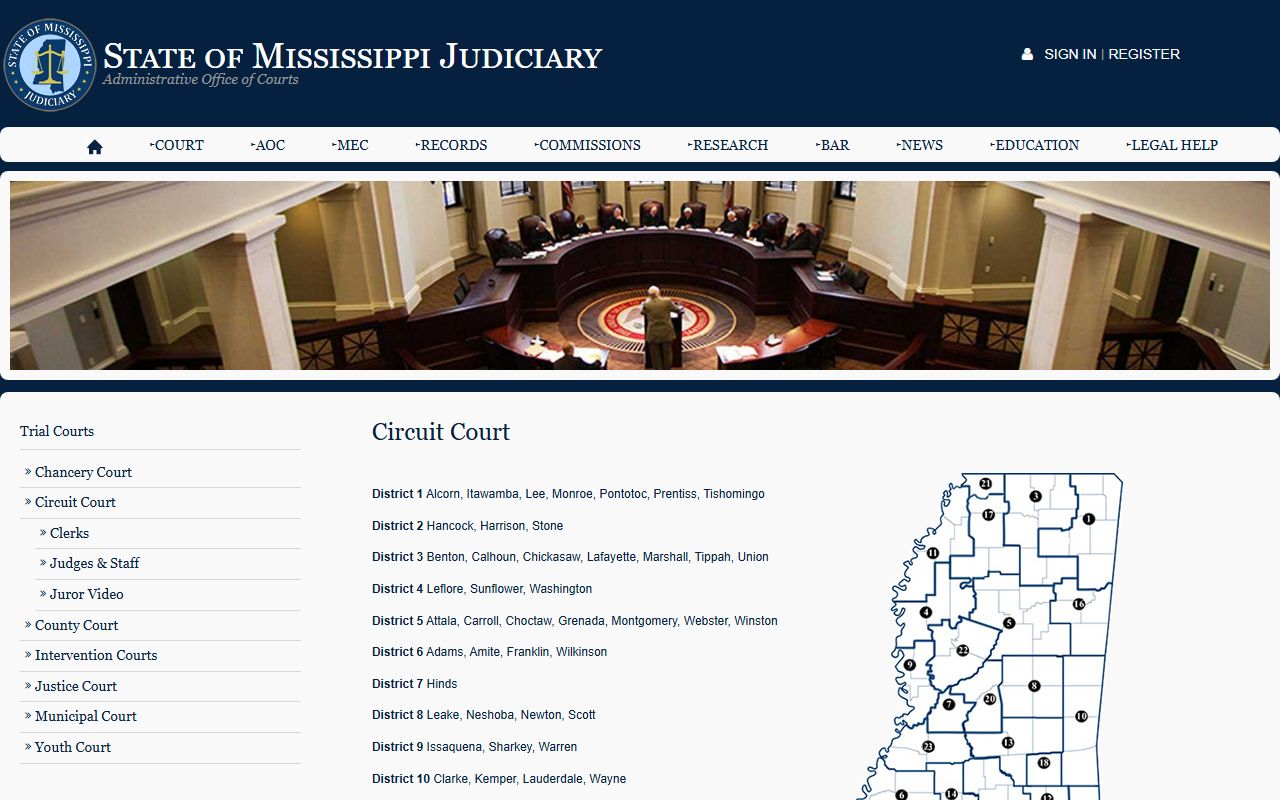
That statewide framework explains why a Winston County felony file sits in Circuit Court while a city misdemeanor stays in Municipal Court. The court level decides which clerk holds the record and which docket it appears on.
How to Search Winston County Criminal Court Records
Winston County does not run a single criminal case search box. Newer Circuit Court cases are in Mississippi Electronic Courts, known as MEC, and the Fifth Circuit Court District went live on the system on March 22, 2021. Public access to MEC runs through PAMEC, the Public Access to Mississippi Electronic Courts service. For older files, certified copies, or records that are not online, the Circuit Clerk is the starting point.
- Open the county-linked online record access portal or the Public Access to Mississippi Electronic Courts (PAMEC) account page.
- Search by the defendant's name, or by the Circuit Court case number if you have it.
- Narrow the results by court, case type, and filing date.
- Open the case to read the docket entries, the charges, and the disposition.
- Ask the Circuit Clerk at 662-773-3581 for a certified copy when you need one for legal use.
A criminal history compiled from many counties is held at the state level, and federal felonies are searched separately through PACER. A paid citation or a lower-court ticket is not the same as a full Circuit Court case record. The same routing applies across the wider set of Winston County court records, where each office holds its own files.
Stages of a Winston County Criminal Case
A criminal case leaves a trail at each stage, and the docket records every step in order. The flow runs from the charge through the final sentence, and the record shows the date and result of each event along the way.
Case flow: Charges Filed › Arraignment › Pretrial / Motions › Plea or Trial › Disposition › Sentencing
| Stage | What Happens |
|---|---|
| Charges Filed | A grand jury indictment or an affidavit charge bound over from a lower court opens the case in Circuit Court. |
| Arraignment | The defendant appears, the charges are read, and a plea is entered. The docket may show an Arraignment Pending flag until this is done. |
| Pretrial / Motions | Lawyers file motions, exchange discovery, and argue bond, evidence, and other issues. Hearings are set and sometimes continued. |
| Plea or Trial | Most cases end in a plea. Others go to trial before a judge or jury. The docket shows Plea Pending or Trial Pending. |
| Disposition | The outcome is entered: a guilty plea, a verdict, a dismissal, a nolle prosequi, or an acquittal. |
| Sentencing | After a conviction the judge imposes the sentence, which can include prison, probation, post-release supervision, fines, and restitution. |
The Circuit Court docket uses status flags that track these stages, such as Bench Warrant Issued, Capias Pending, Nolle Pros Pending, Probation, and Closed. Reading those flags tells you where a case stands without opening every single filing.
What a Winston County Criminal Court Record Shows
A criminal case file holds far more than a charge name. Case-level information generally includes the case number, the court, the filing date, the parties, the category, the status, docket entries, hearing settings, the judge, attorney entries when available, the disposition, and any money owed. A felony file may also carry the charging instrument, bond terms, the plea, the sentence, probation or post-release supervision terms, warrant entries, and restitution.
| Field | What It Shows |
|---|---|
| Case Number | The unique Circuit Court file number used to pull and cite the case. |
| Defendant | The accused person's name and the identifying details the court keeps. |
| Charges | Each charge as filed, tied to the Mississippi statute it is brought under. |
| Plea | The defendant's formal answer, such as guilty or not guilty, entered at arraignment. |
| Disposition | The case outcome: a conviction, a dismissal, a nolle prosequi, or an acquittal. |
| Sentence | The punishment after a conviction, from prison or probation to fines and restitution. |
Charges vs. Convictions
Being charged is not the same as being convicted. A charge is an accusation that opens the case. A conviction is the finding of guilt by plea or verdict. A Winston County criminal record can show charges that were later dropped, dismissed, reduced, or that ended in acquittal, and those entries stay in the public file unless a court orders otherwise. Reading the disposition, not just the charge, is the only way to know how a case ended. The charges as filed, and how they shift over time, are covered in more depth on the Winston County arrest records and court charges page.
| Charge | Conviction | |
|---|---|---|
| Stage | Accusation | Verdict or plea |
| Burden of Proof | Probable cause | Beyond reasonable doubt |
| Public Record | Yes | Yes |
Reading Winston County Criminal Dispositions
The disposition line is the heart of a criminal record. Common entries include guilty, not guilty, dismissed, nolle prosequi, and pretrial intervention. A guilty plea or verdict leads to a sentence. A dismissal or nolle prosequi, the prosecutor's formal choice not to proceed, ends the charge without a conviction. Mississippi Circuit Courts also use pretrial intervention, which can hold a case open while a defendant completes set conditions, and the docket may show Pretrial Interv Pending.
A sentence in the record can combine several parts. It may list a term of years, time suspended, probation, post-release supervision, fines, court costs, and restitution to a victim. Probation and supervision terms appear as flags such as Probation or PRS Viol Pend when a violation is alleged. A long docket can look dense, but the disposition and sentence lines carry the result a reader usually wants.
Note: A closed Winston County case keeps its full docket, so a dismissed or acquitted charge stays visible to the public until a court seals or expunges it.
Sealed vs. Expunged Records
Mississippi law lets some records leave public view. Sealing hides a record from public search while it still exists for limited official use. Expunction goes further and removes eligible records from public access, which changes what clerks, police, and public systems may disclose. Under Miss. Code Ann. Section 99-19-71, eligible dismissals, acquittals, dropped charges, no-disposition cases, and certain convictions may be expunged by petition. Eligibility depends on the offense, prior history, the waiting period, and a court order. The Circuit Court docket can show an EXPUNGED or SEALED flag. Expunction does not erase every trace, so the safest step is to file in the court that handled the case.
| Sealed | Expunged | |
|---|---|---|
| Visibility | Hidden from public | Removed from public access |
| Law Enforcement | Limited access | Very limited |
| Eligibility | By court order in qualifying cases | By petition under Section 99-19-71, based on offense, priors, and timing |
Public Access to Criminal Court Records
Mississippi treats most court files as public records. Criminal case files in Circuit Court are open unless a statute or a court order restricts them. Some judicial work product is exempt from the Public Records Act under Section 9-1-38. When a record is not online, a focused request to the Circuit Clerk that names the parties, the case number, and the approximate year works far better than a broad question.
Key Statutes:
Mississippi Code § 25-61-5 - public bodies must allow inspection and copying of public records and explain in writing when a record cannot be produced in the stated time.
Mississippi Code § 99-19-71 - sets out when eligible criminal records may be expunged from public access by petition.
County and Federal Criminal Cases
Not every serious charge from Winston County becomes a Circuit Court case. Federal crimes are prosecuted in the U.S. District Court for the Northern District of Mississippi, which covers Winston County, and those files are not held by the county clerks. Federal dockets are searched through PACER, not through the Circuit Clerk or MEC. A drug, firearm, or fraud case charged by federal prosecutors may leave no Circuit Court file at all, so a complete search sometimes means checking both the state and the federal systems. The district court's own site explains its courthouses and case access at msnd.uscourts.gov.
Background Check Considerations
A casual record lookup is not the same as a background check used to make decisions. The federal Fair Credit Reporting Act, known as the FCRA, governs reports used for employment, housing, credit, and insurance, and those reports must come from a regulated consumer reporting agency that follows accuracy and notice rules. A name match in a public docket is a starting point, not a verified report, and common names produce false hits.
Important: This is not an FCRA-regulated consumer reporting agency, and nothing here may be used to decide on employment, housing, credit, insurance, or any other FCRA-covered purpose.
Restricted Criminal Court Records in Winston County
Some criminal matters never appear in a public search. Youth court records are confidential under Mississippi law, and the Chancery Clerk serves as Youth Court Clerk for the county. Miss. Code Ann. Section 43-21-251 makes youth court records confidential, and Section 43-21-261 limits who may see them to a short list of authorized people and uses. Sealed and expunged cases are withheld or stripped of detail. Active investigations, certain victim and witness information, and personal identifiers such as Social Security and account numbers are also kept out of public view.
The narrow rules for disclosing youth court records are set out in Mississippi Code Section 43-21-261, summarized on the FindLaw statute page.
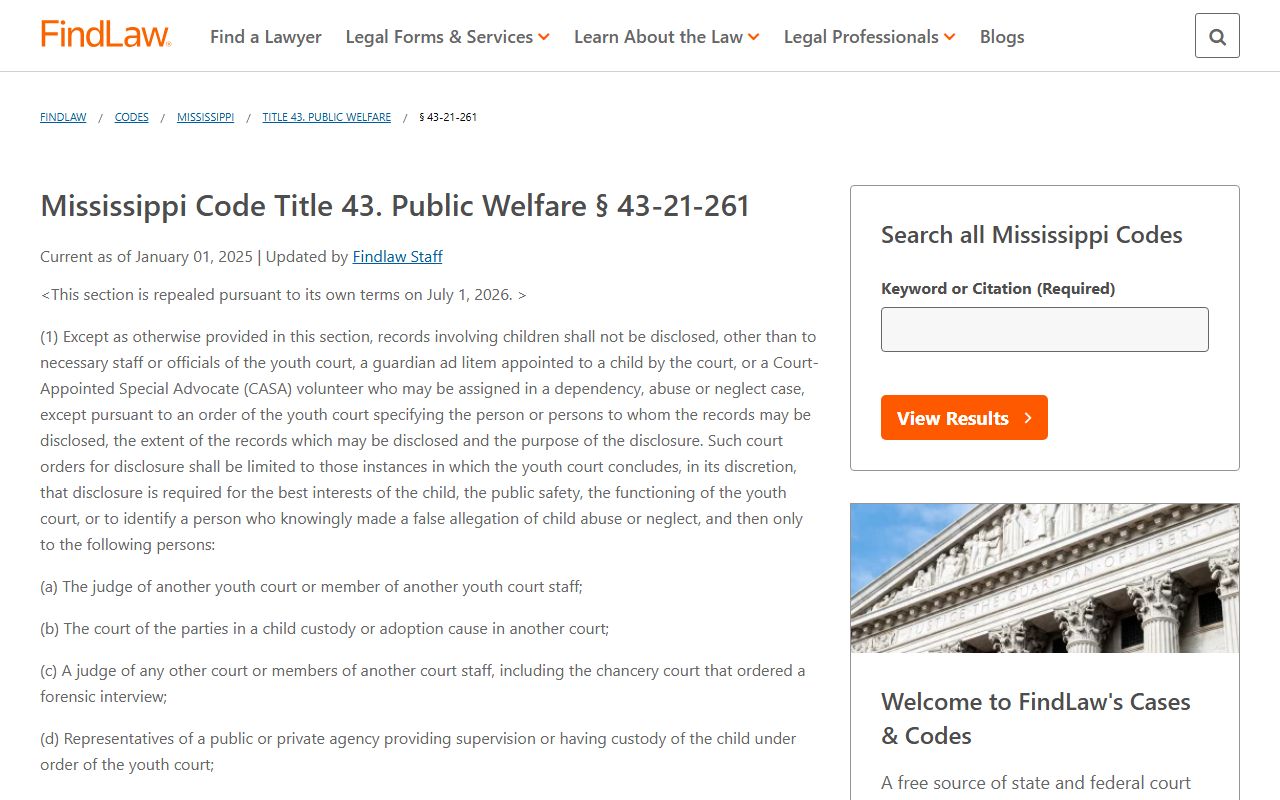
Because of those limits, a juvenile matter will not turn up in an ordinary Winston County criminal court records search the way an adult felony does. For any restricted file, the path is to ask the court that handled the case whether you are an authorized requester, since the clerk cannot release what a statute or order protects.