
Winston County Arrest Records and Court Charges
A Winston County arrest record is the account of an arrest itself: who was taken into custody, which agency made the arrest, and the booking that followed. In this county, arrests are made by the Winston County Sheriff's Office, the Louisville Police, and state officers, and a person booked into local custody is held at the Winston-Choctaw County Regional Correctional Facility. An arrest record is not a finding of guilt. It is the first official mark that a case may be coming. The booking and jail side of that record, including who is in custody, is covered on the Winston County inmate records page.
The court charge record is a different file. After an arrest, a prosecutor reviews the case and decides the formal charges, then files them with the court clerk. Those charges, not the arrest, are what the court tracks through the case. In Winston County, lower-level affidavit charges run through Justice Court or Louisville Municipal Court, while felony charges move to Circuit Court. The court charges after arrest can be amended, reduced, dropped, or replaced as the case develops, and the full case file with the final outcome lives on the Winston County criminal court records page.
How to Find Winston County Arrest Records
Charges and their current status show up in the court's case index, not in a mugshot gallery. Newer Circuit Court cases are in Mississippi Electronic Courts, known as MEC, and the public reaches them through PAMEC. Justice Court citation and affidavit matters are handled by that court, and Louisville Municipal Court keeps its own city cases. Booking detail and who is in custody belong to the jail, so the arrest side is searched separately from the charge record.
- Open the county-linked online record access portal or the Public Access to Mississippi Electronic Courts (PAMEC) account page.
- Search by the defendant's name, or by the case number if you have it.
- Open the case and read the list of charges as filed.
- Check each charge's statute code, level, and current status.
For arrest and booking detail, the jail roster and custody tools are the better route, and a statewide criminal history pulls charges together from many counties. A single citation lookup, by contrast, only confirms one ticket. When a record is not online, the clerk that holds the file can take a focused request by phone, mail, or counter.
How Winston County Charges Get Filed
The charge record begins when a prosecutor files a charging document. The arrest puts a person in the system; the charging document puts the case before the court. Mississippi uses three main forms. A complaint or affidavit charge is common for misdemeanors and starts many lower-court cases. Felonies usually proceed by indictment, the charging document returned by a grand jury, and the Circuit Clerk files indictments as part of the criminal docket. An information is a charge filed directly by the prosecutor in some felony matters, often when a defendant waives indictment.
| Complaint | Information | Indictment | |
|---|---|---|---|
| Filed By | Officer / Prosecutor | Prosecutor | Grand Jury |
| Common For | Misdemeanors | Many felonies | Serious felonies |
| Starts | The case | The case | The case |
Who Files Charges in Winston County
Different prosecutors handle different levels. The County Prosecutor, Zachary Madison, prosecutes Justice Court matters, including affidavit charges and preliminary criminal business. Felony cases in Circuit Court are prosecuted by the District Attorney for the Fifth Circuit Court District after a grand jury indicts or a lower court binds the case over. Police and deputies make the arrest and may swear an affidavit charge, but the decision to file, amend, or drop a formal charge belongs to the prosecutor, not the arresting officer.
Defendants who cannot afford a lawyer may be appointed a public defender. Winston County Justice Court lists public defenders Bruce Brown and Austin Vollor, and felony-level appointments draw on Mississippi's broader public-defense system. A public defender represents the accused. The office does not keep or release the case file, which stays with the court clerk.
The Mississippi Office of State Public Defender keeps a directory of public defenders across the state on its find a public defender page.
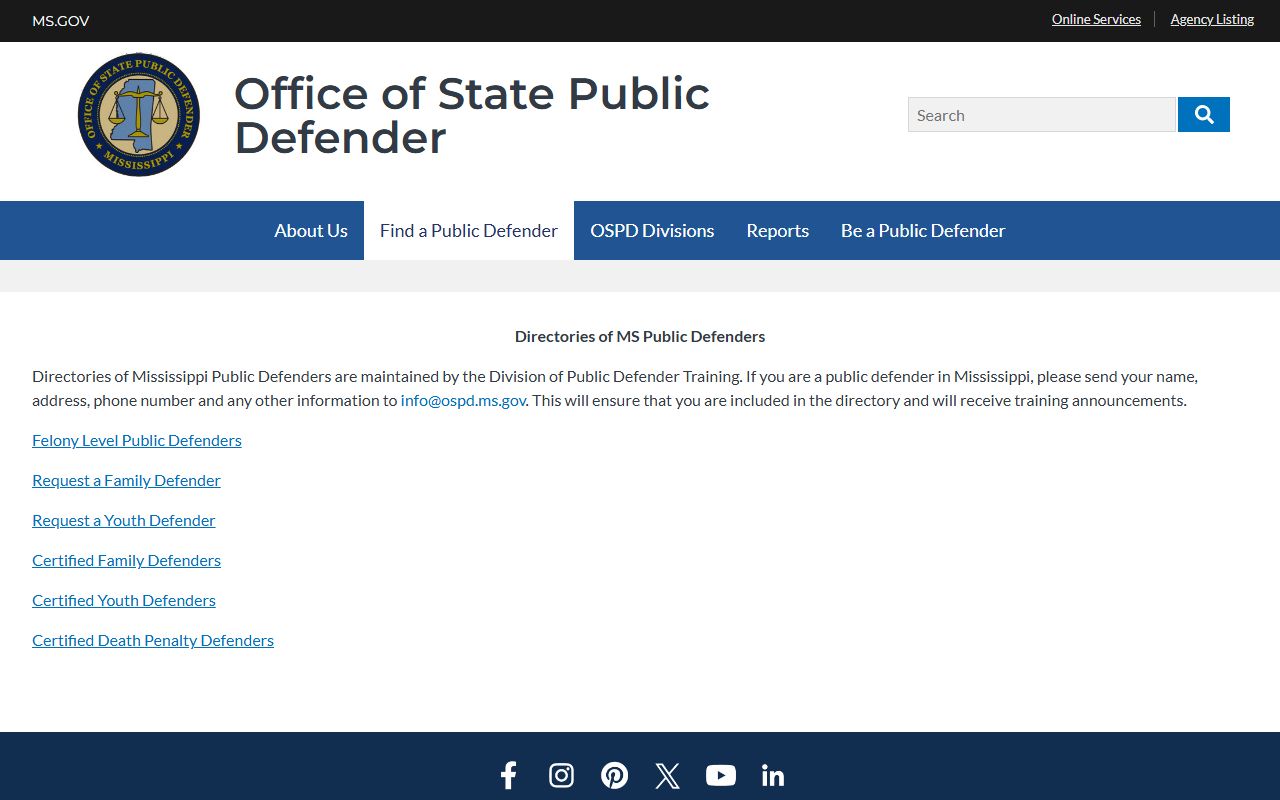
That statewide directory matters when a felony charge moves to Circuit Court and the court must appoint counsel for an eligible defendant. The prosecutor and the defense lawyer are named in the case record, but neither one is the records custodian.
Winston County Charge Status
A charge is not fixed once it is filed. As a case moves, the prosecutor and the court can change it. A count may be amended to a different offense, reduced to a lesser charge, added, dropped, or dismissed. The Circuit Court docket uses status flags such as Nolle Pros Pending, Plea Pending, and Closed to mark where each charge stands. Reading the current status is the only way to know whether a charge is still live.
| Status | What It Means |
|---|---|
| Pending | The charge is filed and the case is still moving toward a plea, a trial, or a dismissal. |
| Amended / Reduced | The prosecutor changed the charge, often to a lesser offense or a corrected statute. |
| Dismissed | The court ended the charge without a conviction, by motion or order. |
| Nolle Prosequi | The prosecutor formally chose not to proceed on the charge. |
Note: A dropped or dismissed Winston County charge can stay visible in the public record until the person petitions a court to seal or expunge it.
Charges vs. Convictions
A charge is an accusation; a conviction is a finding of guilt. The two are easy to confuse in a record, but they carry very different weight. A charge rests on probable cause and only opens the case. A conviction requires proof beyond a reasonable doubt and comes by guilty plea or verdict. A Winston County charge record can list counts that never led to a conviction, so the disposition, not the charge name, tells the real outcome.
| Charge | Conviction | |
|---|---|---|
| Stage | Accusation | Verdict or plea |
| Burden of Proof | Probable cause | Beyond reasonable doubt |
| Public Record | Yes | Yes |
Sealed vs. Expunged Records
Mississippi law lets some charge records leave public view. Sealing hides a record from public search while it still exists for limited official use. Expunction removes eligible records from public access and limits what clerks and police may disclose. Under Miss. Code Ann. Section 99-19-71, eligible dismissals, acquittals, dropped charges, no-disposition cases, and certain convictions may be expunged by petition, with eligibility tied to the offense, prior history, and a waiting period. A person usually petitions the court that handled the charge: the Circuit Clerk for felonies, or the lower court for affidavit charges.
| Sealed | Expunged | |
|---|---|---|
| Visibility | Hidden from public | Removed from public access |
| Law Enforcement | Limited access | Very limited |
| Eligibility | By court order in qualifying cases | By petition under Section 99-19-71, based on offense, priors, and timing |
Winston County Charge Codes and Levels
Each charge is tied to a Mississippi statute, and that code sets the offense and its severity. Charges fall into broad levels: felonies, the most serious offenses heard in Circuit Court; misdemeanors, lesser offenses often handled in Justice or Municipal Court; and minor citations such as traffic infractions. A single arrest can produce several separate charges at once, each with its own code, level, and status.
The statute number on a charge is what links it to the law the state says was broken, and it controls where the case is heard and how it can end. Two people arrested in the same incident can face different charges, and a charge can be swapped for another code if the prosecutor reads the facts differently. That is why the code and the level, not just the plain-English label, matter when reading a charge record.
Statewide Charge and History Lookups
Local court files only show one county's cases. A fuller criminal history pulls charges together from across Mississippi and is held at the state level. For driving-related charges, the Mississippi Department of Public Safety keeps driver-record data and sells a motor vehicle record, which is a separate file from the court case. Background screeners use statewide and multistate databases that reach beyond any single clerk's index.
Each source has its own request rules, fees, and limits, and none of them replaces the certified record from the court that handled the charge. The DPS Driver Records Division explains its driver-record services at driverservicebureau.dps.ms.gov. For a court case, the clerk's certified copy remains the document of record.
Winston County Federal Charges
Some Winston County arrests lead to federal charges instead of state ones. Winston County sits in the U.S. District Court for the Northern District of Mississippi, and federal statute 28 U.S.C. 104 places the county in that district's Aberdeen Division. When federal prosecutors bring the charge, the case is filed in federal court, not in Circuit Court, and the county clerks hold no file for it. Federal charge records are searched through PACER. A multi-agency takedown that led to arrests in Winston County, for example, was charged in the Northern District rather than in county court.
The division boundaries that put Winston County in the Northern District of Mississippi are set in 28 U.S.C. 104.
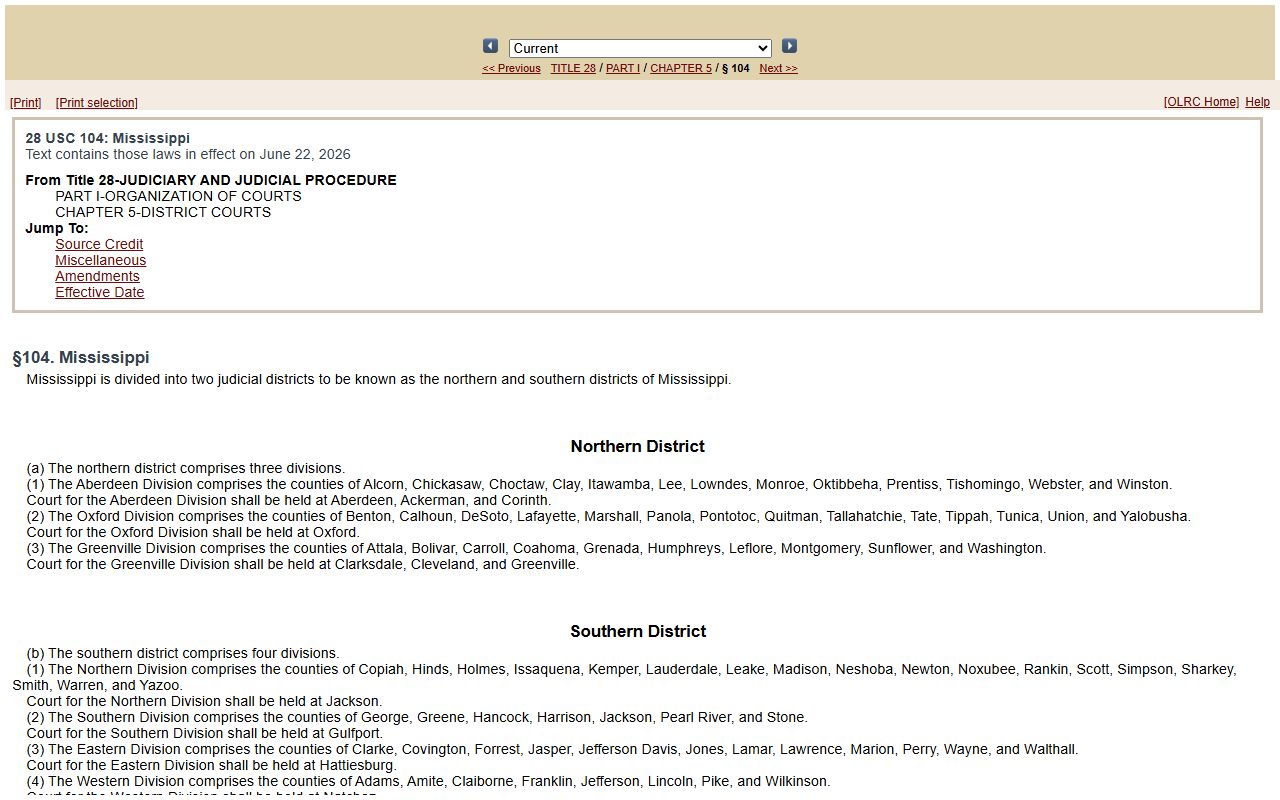
That federal map explains why some local arrests never produce a Winston County Circuit Court charge record at all. A complete charge search may mean checking both the state and the federal systems.
Background Check Considerations
A quick record search is not a regulated background check. The federal Fair Credit Reporting Act, known as the FCRA, controls reports used for employment, housing, credit, and insurance, and those must come from a consumer reporting agency that follows strict accuracy and notice rules. A charge listed in a public docket is raw data, not a verified report, and a dismissed or expunged charge should never be treated as a conviction.
Important: This is not an FCRA-regulated consumer reporting agency, and the charge information here may not be used for employment, housing, credit, insurance, or any other FCRA-covered decision.
Restricted Charge Records in Winston County
Not every charge is open to the public. Juvenile charges handled in youth court are confidential under Mississippi law and are not searched like adult cases. Sealed and expunged charges are withheld or removed from public systems. Charges tied to an active investigation, along with certain victim and witness details, can be held back, and personal identifiers such as Social Security and account numbers are redacted.
For a restricted file, the only path is to ask the court that handled the charge whether you are an authorized requester, since a clerk cannot release what a statute or a court order protects. A blank result does not always mean no charge exists; it can mean the record is sealed, expunged, or held by another court.